Shift Non-Productive Time Away from the Machine
Anything that can be prepared, checked, or structured before cutting should not be done on the machine. That is one of the most important starting points for higher productivity and better utilization.
Digital Manufacturing
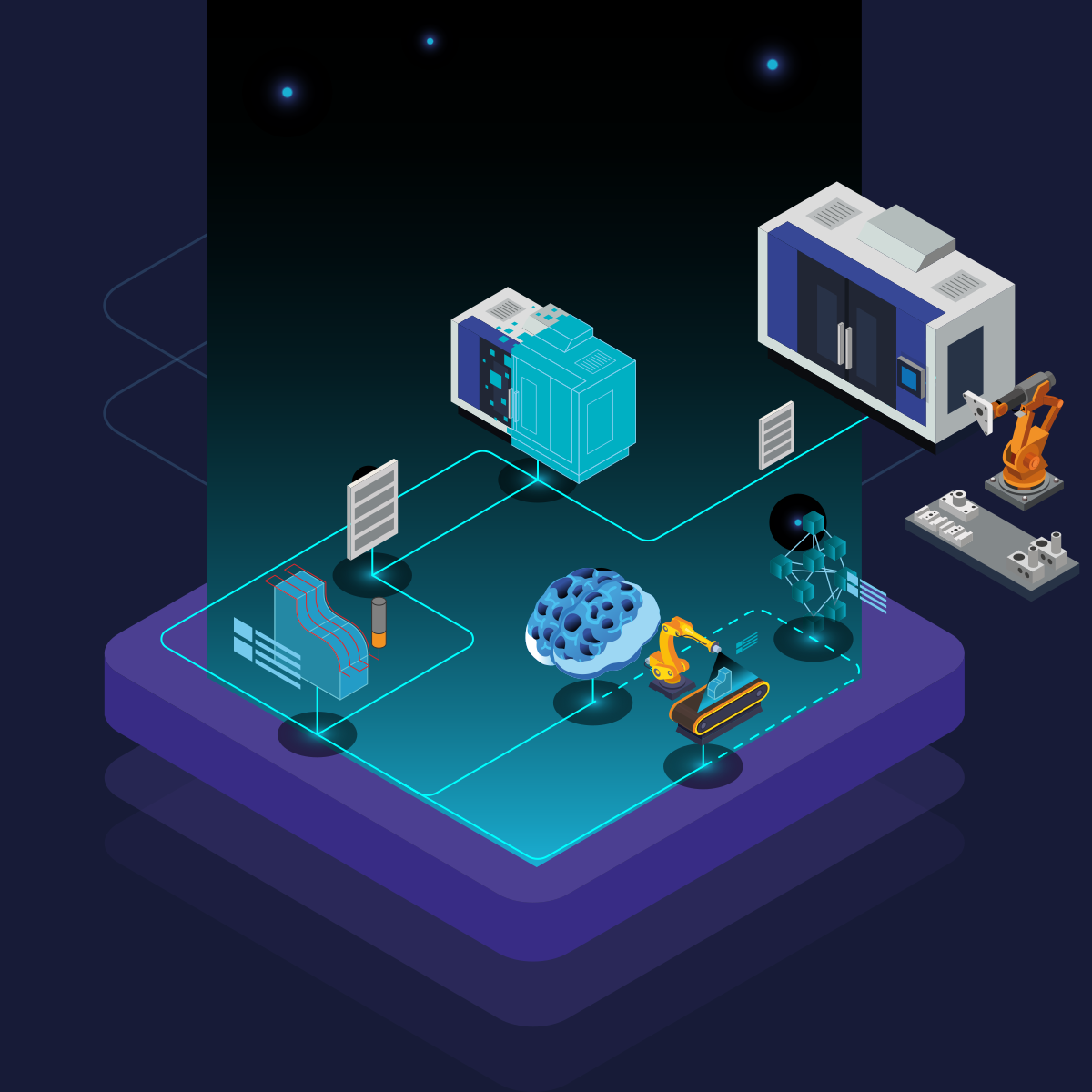
We help move preparation, verification, and manufacturing knowledge from the machine into a stable digital workflow - from CAD model through CAM and postprocessor to a verified NC program.
What We Mean by Digital Manufacturing
Digital manufacturing does not mean introducing as many systems as possible. What matters is a traceable workflow from drawing or CAD model through CAM, postprocessor, and verification to an NC program that starts more safely on the machine.
Many manufacturers face the same situation: smaller lot sizes, more part variants, limited skilled labor, growing documentation requirements, and the desire for more automation. This does not call for a generic digitalization formula, but for a solution that fits the machine, control, part spectrum, organization, and available data.
Where Digital Manufacturing Becomes Relevant
Value is created where less time is tied up at the machine, recurring decisions are prepared cleanly, and manufacturing knowledge becomes reliably available.
Anything that can be prepared, checked, or structured before cutting should not be done on the machine. That is one of the most important starting points for higher productivity and better utilization.
Especially with small lot sizes and high part variety, what is needed is not a standard formula, but a clear framework for describing and applying recurring decisions, rules, and workflows in a consistent way.
When manufacturing knowledge exists only in people’s heads, growth and stability become difficult. Digital Manufacturing creates the basis for making knowledge available in rules, templates, and reusable processes.
When processes are described and prepared clearly in digital form, manufacturing knowledge becomes usable not just locally but across sites - with greater transparency and less dependence on individual people.
Building Blocks of the Solution
For us, Digital Manufacturing is not a standalone discipline. It emerges from several topics that each make a distinct contribution and must be brought together meaningfully in practice.
The digital twin moves program verification, virtual prove-out, commissioning, and training into a virtual machine environment.
Rule-based CAM automation helps apply recurring programming decisions, strategies, and tool logic consistently.
Knowledge must be moved out of people’s heads into reliable structures if processes are to become repeatable, scalable, and less dependent on individuals.
Every company needs its own approach. That is why, for us, Digital Manufacturing does not begin with software, but with a precise assessment of workflows.
Why Digital Manufacturing with Pimpel
Digital manufacturing cannot be introduced as a standard package. Machines, controls, part families, postprocessors, data quality, and working methods differ too much. A useful project therefore starts with the question of where time is currently lost and which preparation can realistically be moved away from the machine.
Together, we clarify which nonproductive times can be reduced, which decisions can be standardized, which data is missing, and where automation makes business sense. This creates not an abstract digitalization concept, but a reliable basis for better CNC and CAM workflows.
Customer story
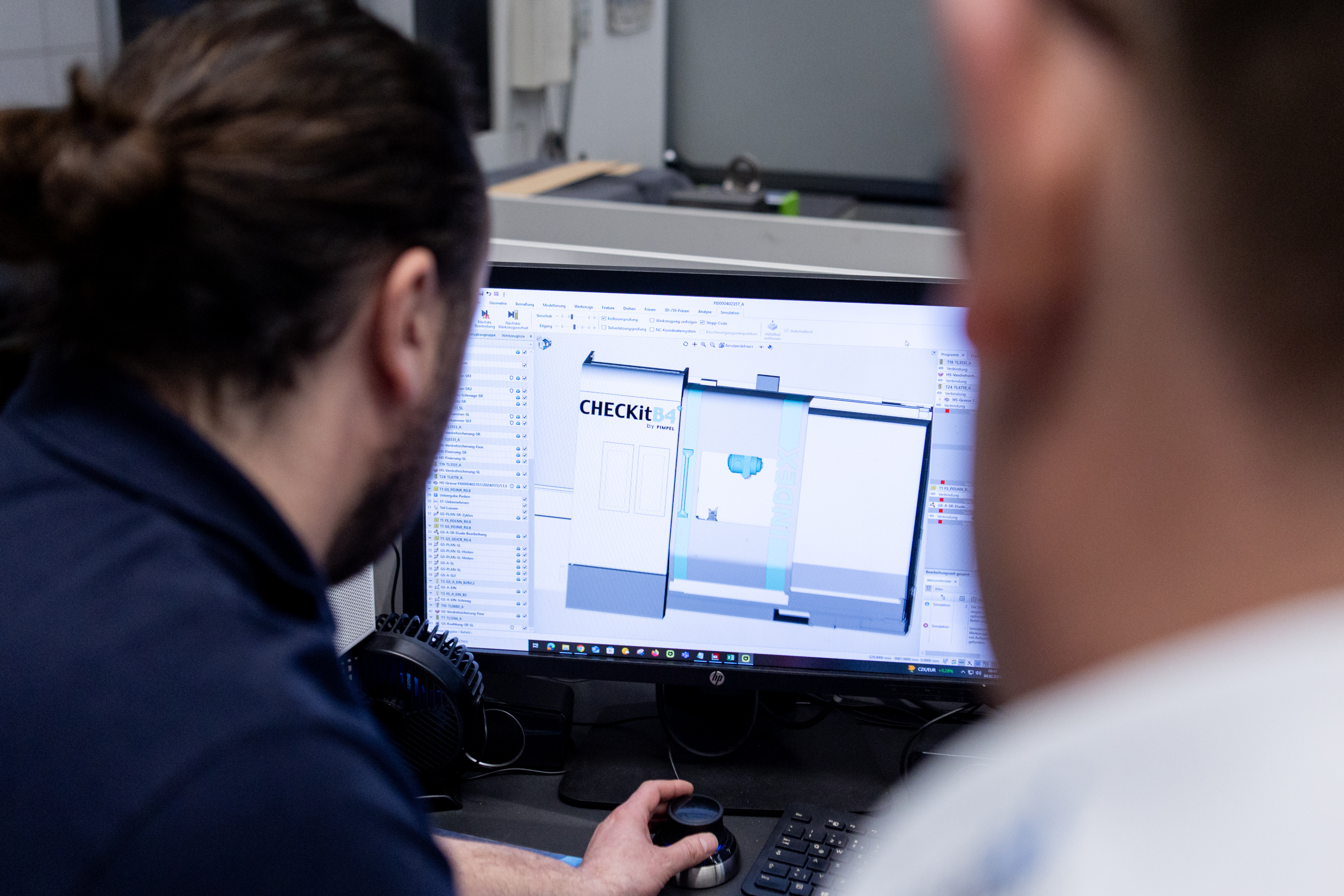
Tool Service uses ESPRIT and CHECKitB4 to program single parts parallel to main production time, verify them virtually and manufacture them automatically.
Task
High process reliability in automated single-part production and complete machining, without test pieces, scrap or long run-in times.
Solution
ESPRIT for CAM programming and CHECKitB4 as a digital twin for complete NC verification with real control logic.
Customer value
More machine running time, less scrap, shorter throughput times and a high level of confidence for machine operators and work preparation.
„Automated, unmanned manufacturing of different single parts is the greatest challenge in contract manufacturing. CHECKitB4 from Pimpel gives us the necessary security.“
FAQ
The following questions reflect points that regularly come up with manufacturing managers, process planners, CAM programmers, and project owners.
Orientation meeting
We discuss nonproductive time, part variety, programming effort, and where preparation, verification, and manufacturing knowledge can be moved upstream from the machine.