CNC Digital Twin
Digital twin of a CNC machine and its verification depth
A CNC digital twin provides useful results only when the machine model, control representation, data revision, and intended task are aligned.
Kurzüberblick
3D model, virtual machine, and digital twin
These terms describe different systems. Training, NC verification, and condition analysis each require different data and connections.
Not every digital machine representation is a digital twin
In CNC manufacturing, 3D models, kinematic machine models, virtual CNC systems, and digital twins are often grouped under the same term. Technically, however, they perform different tasks. A static model shows geometry but cannot execute control commands or represent the current state of a real machine.
In the narrower manufacturing sense, a digital twin is a purpose-specific digital representation with a defined connection to the real manufacturing element. Which data are exchanged or synchronized depends on the use case. A 3D model by itself does not meet this requirement.
The 3D model shows shape and available space
A geometric model describes machine components, enclosure, table, spindle, and other bodies. It can support layout planning, training, or a basic visual collision review. Motion is possible only when kinematics with axes and travel ranges are also defined.
Even a movable machine model does not yet know the control logic. It does not automatically understand how cycles, transformations, tool compensation, or machine functions are executed. Additional components are therefore required for NC verification.
A virtual machine represents motion and functions
A kinematic virtual machine describes axes, motion limits, and spatial relationships. Depending on the system, it can be used to check toolpaths, collision zones, and machine motion. The value of the result depends on how accurately the model, workholding, and tool assemblies are maintained.
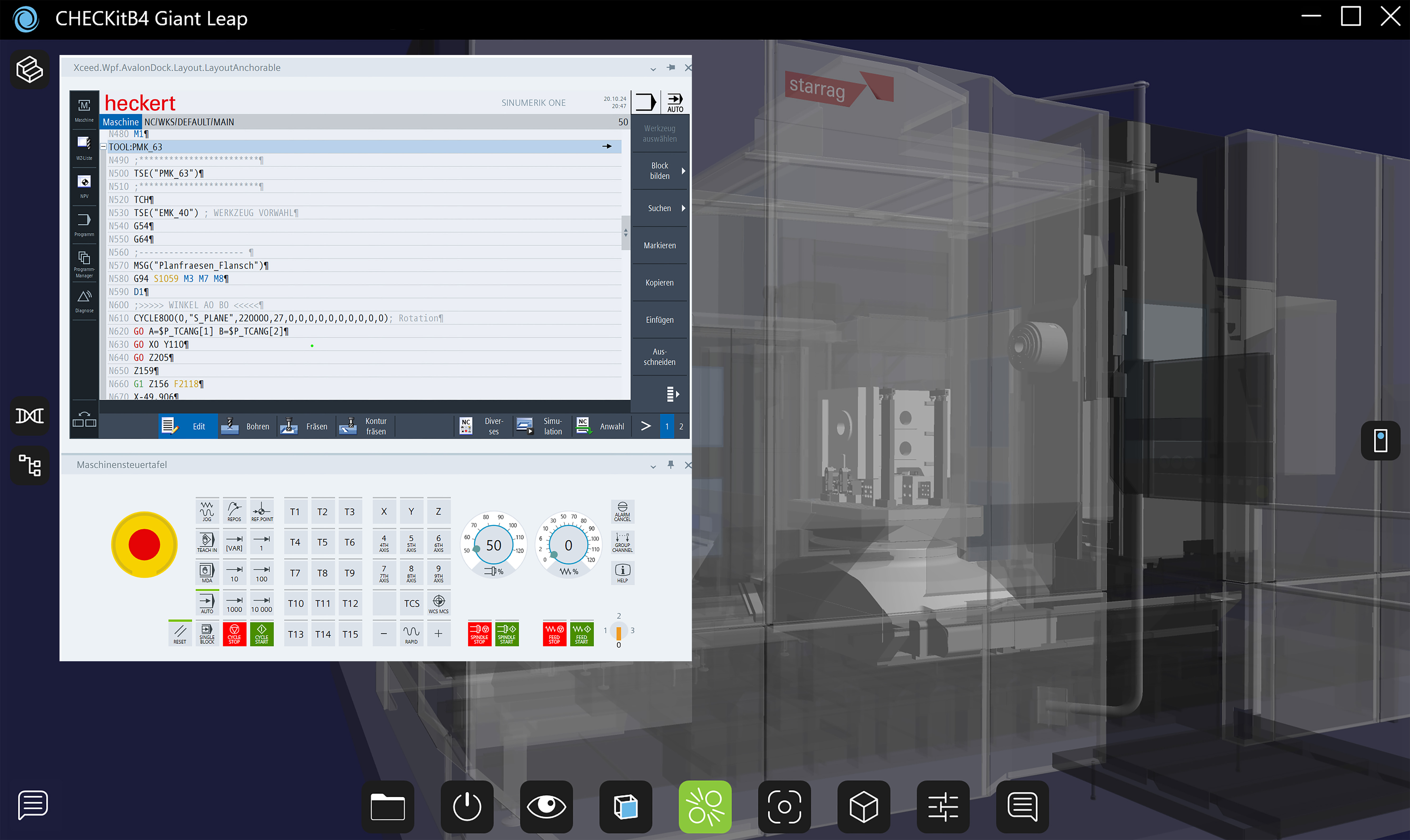
An executable virtual CNC adds control software or an interpreter that processes NC code. This makes it possible to examine machine-specific commands, cycles, and transformations closer to the real control. The available functions may still differ from the actual machine.
A digital twin needs a defined connection to the real machine
A digital twin is built for a specific task and connected to the real manufacturing element. This connection may include master data, configuration, measurements, states, or other runtime data. It must be clearly documented which information is transferred and how current it is.
A virtual machine created once therefore does not automatically become a digital twin. The intended use and controlled synchronization with the real machine determine whether the term is technically appropriate. The scope and freshness of the connection must be documented.
Each task requires different data
Operator training places particular importance on the control interface, machine responses, and typical workflows. Collision checking, by contrast, requires accurate geometries, workholding, tool assemblies, and axis limits. NC validation also requires an interpreter, cycles, transformations, and a suitable postprocessor.
Condition monitoring or process analysis requires current data from the real machine. This may include axis positions, spindle load, messages, or operating states. A model that is sufficient for training is therefore not automatically suitable for NC approval or condition assessment.
Example of a new five-axis program
A manufacturer wants to check a new five-axis program before occupying the machine. A geometric model can show whether the tool, holder, and workholding fit within the planned work area. A kinematic simulation adds rotary-axis motion and axis limits.
Verifying the posted NC code also requires the actual control logic, transformations, and machine-specific functions. Only when these data match the real machine configuration can the result be transferred to production.
Configuration revisions must be assigned unambiguously
Machine options, software versions, tool changers, workholding, and postprocessors change the behavior of the digital system. It must therefore be clear which real machine and point in time a model represents. Without this assignment, a verification result may be based on an outdated configuration.
Changes should be version-controlled and linked to the affected verification activities. This is especially important after control updates, machine modifications, and postprocessor changes. A current model is useful only when its revision is known in daily operations.
What can be checked with a digital twin
Depending on its design, a digital twin can support operator training, NC program testing, collision analysis, and axis-limit checks. Other applications include virtual commissioning, process analysis, and condition evaluation. None of these tasks is automatically included in every product or machine project.
A specific question should therefore be defined before implementation. Is the goal to reduce machine time during prove-out, train operators, or analyze condition data? Only then can the required models, interfaces, and data be determined.
Not every real-world influence can be reproduced completely
Vibration, tool wear, chip formation, temperature, and the actual rigidity of a setup are simplified or not represented at all in many systems. The condition of the machine and tools may also differ between the virtual model and production. A collision-free simulation is therefore not a complete statement about process stability.
A digital twin can move verification work upstream and reveal known risks. Responsibility for approval, setup, and safe machining still remains in the real process. The checks that must continue to be performed on the machine need to be defined for each use case.
Frequently asked questions about the digital twin of a CNC machine
**Is every CNC machine simulation already a digital twin?**
No. A simulation can operate without a connection to the real machine. A digital twin requires a defined purpose and controlled coupling or synchronization with the real manufacturing element.
**Can a digital twin completely replace prove-out?**
It can move many checks upstream and reduce machine occupancy. Real factors such as the clamping condition, tool wear, and process vibration still have to be evaluated on the machine where the application requires it.